
I am Arai from the Research and Development Department.
In this article, I used a waterfall—one of nature’s water-flow phenomena—as an analogy for what happens when a metal part is chamfered.
This comparison helped me better understand the effect of the V-shaped cutting edge of the XEBEC Burrless Chamfering Cutter.
About chamfering: https://www.xebec-tech.com/en/study/about_chamfering
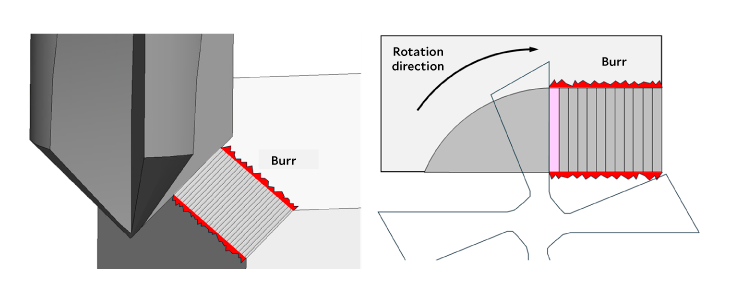
First, let us look at what happens when chamfering with a conventional straight-edge cutter.
With this type of cutter, the entire straight cutting edge engages the material. The removed metal is pushed toward the outside of the chamfer, where it has no clearly controlled path. As a result, some of the displaced metal remains along the outer edge as a burr.
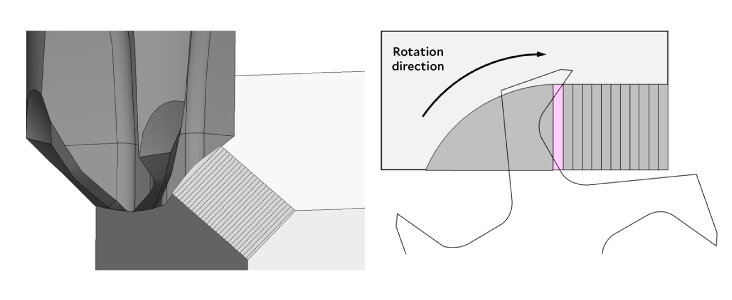
Next, let us look at what happens when chamfering with the XEBEC Burrless Chamfering Cutter. The XEBEC Burrless Chamfering Cutter has the world’s first V-shaped cutting edge.
Product page: https://www.xebec-tech.com/en/products/xc/
Cutting in action (YouTube): https://www.youtube.com/watch?v=Vo9–ndfhIw
With this V-shaped cutting edge, the metal generated during cutting is guided from both sides of the edge toward the inside of the chamfer. As a result, the metal flow is less likely to escape outward, and burr formation during chamfering is suppressed.
To look more deeply at the difference between a straight edge and a V-shaped cutting edge, let us focus on the behavior of metal during cutting.
During cutting operations such as those performed by a chamfering cutter, extremely large shear stress occurs in the metal near the tool cutting edge, exceeding the yield point. At this moment, the metal exhibits a behavior known as plastic flow.
Plastic flow is a phenomenon in which metal, while remaining solid, continuously changes shape and moves in the direction in which force is applied.
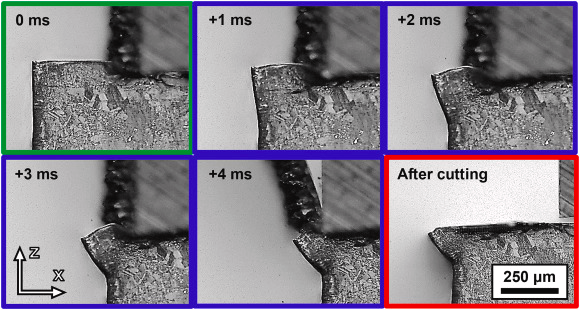
Source: Zannoun, Hamzah, and Julius Schoop. “Analysis of burr formation in finish machining of nickel-based superalloy with worn tools using micro-scale in-situ techniques.” International Journal of Machine Tools and Manufacture 189 (2023): 104030. https://doi.org/10.1016/j.ijmachtools.2023.104030
At this point, the metal is not being crushed like powder, nor is it melting like a liquid. However, depending on how force is applied, it behaves as if it were flowing.
In other words, cutting can be understood as guiding plastically flowing metal according to the shape of the cutting edge. Burrs form when some of this metal is pushed toward an unconstrained outer edge and remains there. The same principle applies to burrs generated during chamfering.
However, because the flow of metal during chamfering is invisible to the naked eye, it can be difficult to visualize. To make the phenomenon easier to understand, let us compare it to a familiar example of water flow in nature: a waterfall.
Shiraito Falls is located in Shizuoka Prefecture in central Japan, near Mount Fuji and southwest of Tokyo.
At Shiraito Falls, countless thin streams of water fall like threads from across an entire rock wall approximately 150 meters wide. This does not happen because water is concentrated upstream. Rather, it occurs because groundwater from Mt. Fuji springs out in a planar manner through gaps in the lava layer.
At Shiraito Falls, there are almost no grooves that gather the water or valleys that guide the flow. It can be described as a state in which the water flow is simply released.

This closely resembles chamfering with a straight-edge chamfering cutter. Cutting occurs simultaneously along the entire straight cutting edge, and the cut metal also flows outward without being given a clear destination. Just like Shiraito Falls, the flow is not being stopped, but neither is it being guided. As a result, there is room for burrs to remain on the outside of the chamfer.
Kegon Falls is located in Tochigi Prefecture, north of Tokyo in eastern Japan.
Kegon Falls gives a completely different impression from Shiraito Falls. The waterfall itself is a single large stream, and upstream from it lies the large Lake Chuzenji. Kegon Falls is formed as the water stored in this wide lake is guided in one direction by the shape of the outlet terrain. The water continues to flow, but the shape of the outlet determines where it goes.
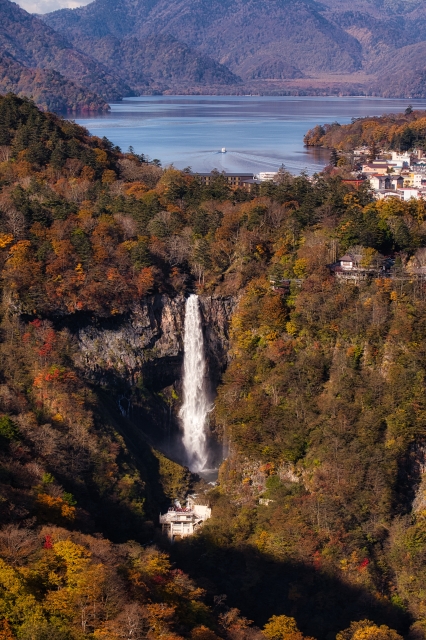
This provides a useful analogy for the function of the V-shaped cutting edge of the XEBEC Burrless Chamfering Cutter. The metal displaced during cutting does not stop flowing. Instead, the geometry of the V-shaped cutting edge guides it toward the inside of the chamfer. Before the metal can escape outward, its flow is directed toward the center, thereby suppressing burr formation along the outer edge of the chamfer.
The examples above show how terrain determines the direction and destination of flowing water. The same principle can be applied to the flow of metal during chamfering. A straight cutting edge allows the metal to spread outward, much like the water at Shiraito Falls. In contrast, a V-shaped cutting edge channels the metal inward, like the concentrated flow of Kegon Falls. This difference in how the material is guided directly affects whether burrs form along the outside of the chamfer.
The XEBEC Burrless Chamfering Cutter therefore suppresses burr formation by using its V-shaped cutting edge to control the flow of metal and guide it toward a defined destination.
XEBEC Technology develops, manufactures, and distributes tools for automated deburring and chamfering of metal parts. Its innovations in the field of deburring include the world’s first ceramic fiber brushes and burrless chamfering cutters.

